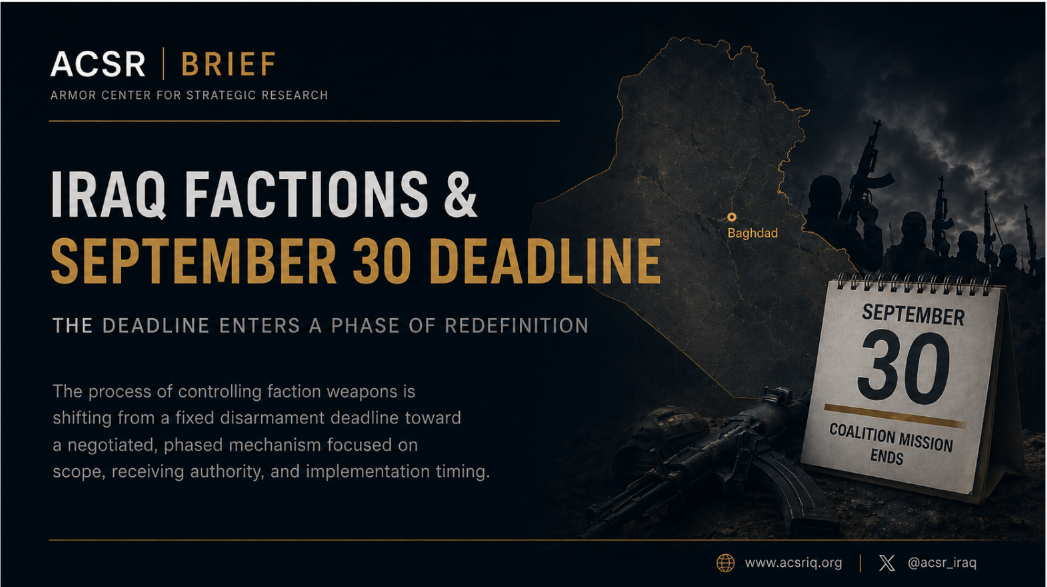
Nouri al-Maliki announced the existence of a joint committee with the armed factions to explore a formula for the “regulation” or “containment” of weapons, with a clear distinction between heavy, medium, and light arms. This indicates that negotiations are no longer focused solely on the principle of weapons handover, but increasingly on its scope and operational definition. Maliki’s office later clarified that its position in support of bringing weapons under state control had not changed. It nevertheless stressed that addressing the issue would require time, understandings, and guarantees, reinforcing the assessment that implementation is likely to extend beyond September 30.
In parallel, National Security Adviser Qasim al-Araji suggested that the Popular Mobilization Forces Commission could become the authority responsible for receiving the factions’ weapons. He also indicated that negotiations would continue beyond September 30 and that the date is primarily linked to the conclusion of the Coalition forces’ mission.
By contrast, Harakat al-Nujaba has escalated its rhetoric regarding the U.S. presence, threatening to target any American forces remaining in Iraq after September 30. This position suggests that the decision to escalate by one of the more hardline factions will depend primarily on how the U.S. withdrawal is implemented, rather than on the weapons handover issue alone.
The available indicators point to a gradual shift in the definition of the political objective itself: from disarming the factions within a fixed deadline to establishing a negotiated containment mechanism focused on heavy weapons and capabilities that directly affect the state’s authority over decisions of war and peace.
ACSR assesses that any initial settlement is likely to include missiles, unmanned aerial vehicles, heavy and medium weapons, and independent strike capabilities, while dealing with light weapons and the factions’ organizational structures may prove slower and more complex.
ACSR further assesses that Baghdad will likely seek to avoid a direct confrontation while securing commitments from the factions not to employ their armed capabilities outside the authority and decision-making framework of the state.